
Description
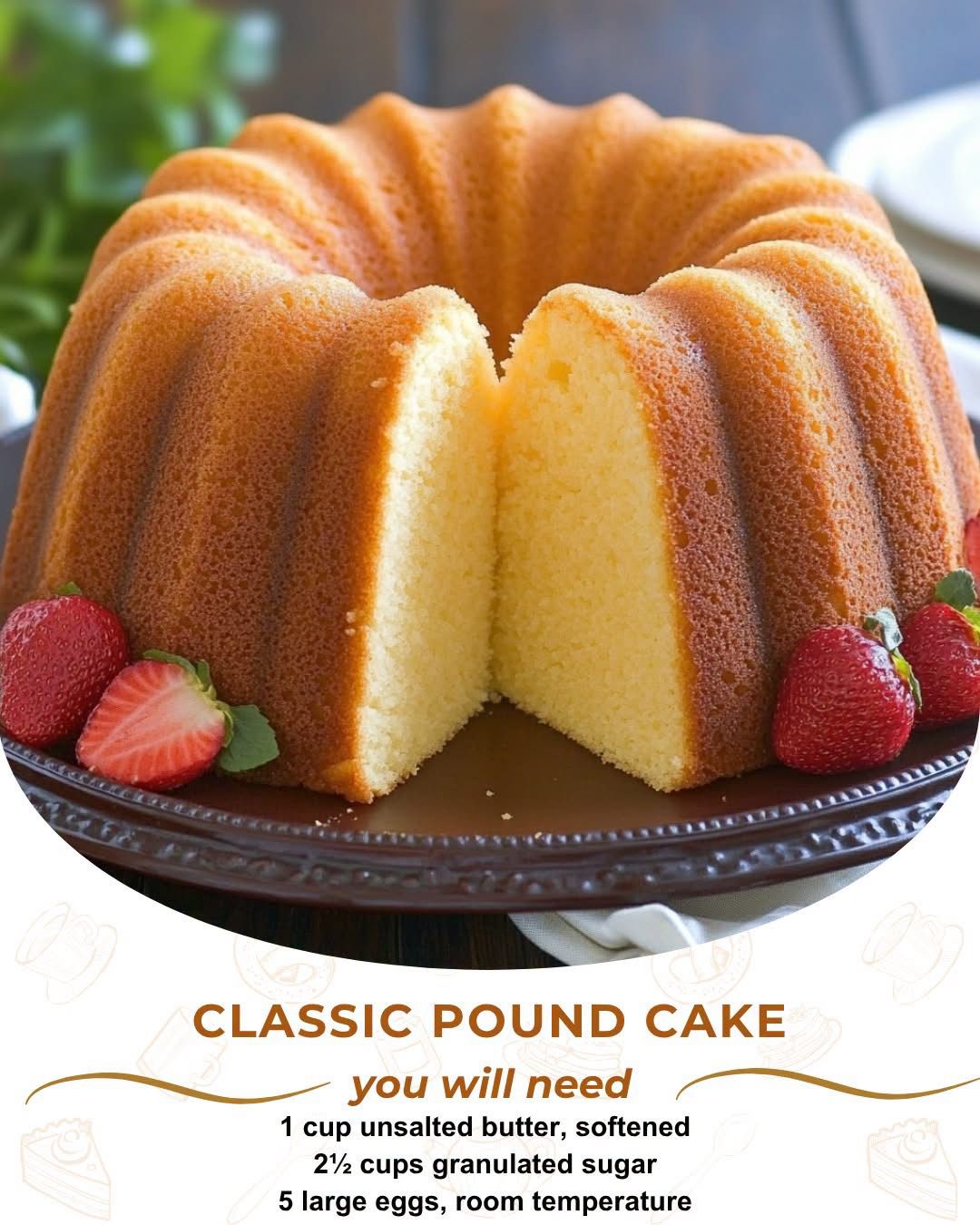
A Classic Pound Cake is characterized by its golden, delicately crisp crust and a dense, fine-grained crumb. Baked into a distinct fluted ring shape using a Bundt pan, this loaf or ring cake offers a tender texture with a subtle buttery gloss and balanced sweetness.
Introduction
The classic pound cake is one of traditional baking’s foundational recipes. Famous for its structural elegance and simplicity, it serves as the baseline for many modern cake variations. It provides a rich flavor profile driven almost entirely by high-quality butter, sugar, and fresh eggs.
Origin and Cultural Significance
Originating in Britain during the early 18th century, the cake derived its name from its original formula: exactly one pound each of flour, butter, sugar, and eggs. Because many households at the time lacked detailed cookbooks or standardized measuring utensils, this straightforward 1:1:1:1 ratio made the recipe easy to remember and execute. Over the centuries, the recipe migrated across the globe, becoming a staple of Southern American cuisine, European tea times, and holiday celebrations, with minor adjustments added to produce a lighter texture.
Ingredients Quantity
- Unsalted butter (softened): 1 cup (226 g)
- Granulated sugar: 2\frac{1}{2} cups (500 g)
- Large eggs (room temperature): 5 large eggs
- All-purpose flour (sifted): 3 cups (360 g)
- Whole milk or buttermilk (room temperature): 1 cup (240 ml)
- Pure vanilla extract: 1 tablespoon (15 ml)
- Fine sea salt: \frac{1}{2} teaspoon (2.5 g)
- Baking powder (optional for extra lift): \frac{1}{2} teaspoon (2 g)
Optional Additions
- Fresh Berries: Strawberries, raspberries, or blueberries served fresh alongside or folded into the batter.
- Citrus Zest: 1–2 tablespoons of fresh lemon, orange, or lime zest rubbed into the sugar before creaming.
- Whipped Cream or Chantilly Cream: A dollop of sweetened vanilla cream for extra richness.
- Simple Glaze: A basic powdered sugar and lemon juice or milk drizzle applied after cooling.
- Warm Spices: \frac{1}{2} teaspoon of ground nutmeg or cinnamon added to the dry ingredients.
Tips for Success
- Room Temperature Ingredients: Ensure butter, eggs, and milk are at room temperature (20\text{–}22^\circ\text{C}) to prevent the emulsion from breaking during mixing.
- Creaming Method: Beat the butter and sugar thoroughly on medium speed for 5–7 minutes until pale and fluffy; this incorporates air essential for rise.
- Pan Preparation: Generously grease every crevice of the Bundt pan with melted butter or baking spray, then dust evenly with flour or sifted powdered sugar.
- Alternate Adding Dry and Wet: Add flour in three batches alternating with the liquid in two batches, beginning and ending with flour, to prevent over-mixing.
- Low and Slow Baking: Bake at a steady moderate temperature to allow the dense interior to cook through without scorching the exterior.
Instructions
- Prep the Oven and Pan: Preheat the oven to 165^\circ\text{C} (325^\circ\text{F}). Thoroughly grease a 10-to-12-cup Bundt pan with butter and dust lightly with flour, tapping out any excess.
- Combine Dry Ingredients: In a medium bowl, whisk together the sifted all-purpose flour, fine sea salt, and baking powder (if using). Set aside.
- Cream Butter and Sugar: In a large mixing bowl or stand mixer fitted with the paddle attachment, beat the softened butter and granulated sugar on medium speed for 5 to 7 minutes until pale yellow and fluffy.
- Add Eggs: Add the room-temperature eggs one at a time, mixing well after each addition and scraping down the sides and bottom of the bowl as needed.
- Mix Dry and Wet Ingredients: Reduce mixer speed to low. Stir the vanilla extract into the milk. Add one-third of the flour mixture to the butter mixture, followed by half of the milk. Repeat, ending with the final third of the flour mixture. Mix just until combined; do not overmix.
- Bake: Pour the batter evenly into the prepared Bundt pan and smooth the top with a spatula. Bake for 60 to 75 minutes, or until a wooden skewer inserted into the center comes out clean or with a few moist crumbs.
- Cool: Allow the cake to cool in the pan on a wire rack for 10–15 minutes. Invert the pan onto the wire rack to release the cake, then cool completely before slicing.
Nutritional Information
Estimated values per slice (based on a 12-slice yield):
| Nutrient | Amount Per Serving |
|---|---|
| Calories | 380\text{–}420\text{ kcal} |
| Total Fat | 18\text{–}22\text{ g} |
| Saturated Fat | 11\text{–}13\text{ g} |
| Cholesterol | 100\text{–}120\text{ mg} |
| Sodium | 180\text{–}220\text{ mg} |
| Total Carbohydrates | 48\text{–}52\text{ g} |
| Dietary Fiber | <1\text{ g} |
| Sugars | 28\text{–}32\text{ g} |
| Protein | 5\text{–}6\text{ g} |
Embracing Healthful Indulgence
While classic pound cake is traditionally rich, mindfully incorporating it into a balanced lifestyle is straightforward:
- Portion Awareness: Enjoying a smaller slice allows you to relish the rich flavor and texture while keeping overall calorie intake aligned with your goals.
- Fruit Pairing: Serve slices alongside fresh high-fiber berries (such as macerated strawberries or raspberries), which add volume, micronutrients, and natural tartness without requiring heavy frostings.
- Lighter Substitutions: For a lighter variation, substitute part of the whole milk with low-fat buttermilk or replace a portion of the butter with plain Greek yogurt to retain moisture with reduced fat content.
Recommendation
Pair a freshly baked slice with unsweetened coffee or Earl Grey tea to contrast the sweetness of the cake. It is best served slightly warm or at room temperature, accompanied by a handful of ripe strawberries.
Conclusion
The Classic Pound Cake remains a enduring centerpiece of home baking. Its structural simplicity, rich flavor profile, and fine crumb make it an adaptable canvas for fresh fruits, simple glazes, or quiet tea-time enjoyment.